

When a truck accident turns your world upside down, the road to justice can feel uncertain and overwhelming. These cases are far more complex than typical car accidents. Multiple parties may be involved, federal regulations may play a role, and the injuries are often severe and life-changing.
For victims and their families, the process of securing fair compensation is not just about legal action; it’s about reclaiming stability and ensuring accountability. These cases require a strategic, evidence-driven approach and a deep understanding of the trucking industry’s unique rules and responsibilities.
In this guide, we outline the essentials of truck accident litigation in Kansas City, from what sets these cases apart to the steps involved in proving liability and securing the compensation a victim deserves. Whether someone is facing the immediate aftermath of an accident or preparing for the legal journey ahead, this guide is here to provide clarity, confidence, and a clearer path forward.
This blog will explain why litigation can help individuals protect their rights following a large trucking accident.
The Unique Dangers of Truck Accidents
Truck accidents are among the most dangerous and severe collisions that take place on Missouri roads. Unlike other types of crashes that involve two cars, accidents involving commercial trucks often result in devastating injuries and fatalities due to the trucks’ sheer size and weight.
Here are some of the top factors that contribute to the severity of commercial truck accidents, and why truck accident litigation in Kansas City is often required in these types of wrecks.
The Size and Weight of Commercial Trucks
Commercial trucks can weigh up to 40 tons (80,000lbs) when fully loaded. This makes them significantly heavier and larger than standard passenger vehicles, which, on average, only weigh around 4,000lbs.
The additional weight of commercial trucks creates a massive force upon impact, which often results in severe damage to smaller vehicles involved. This directly correlates with the injuries sustained by the passengers.
The substantial weight difference affects even low-speed collisions, which can still have devastating outcomes for those in passenger vehicles. The size and weight disparity between commercial trucks and passenger vehicles often causes severe, catastrophic injuries for victims involved in these accidents.
Larger Blind Spots
Commercial trucks have much larger blind spots when compared to passenger vehicles. These are known as “No Zones.” No Zones are areas around the truck where smaller vehicles aren’t visible to the truck driver. These blind spots include:
- Front of truck: This blind spot extends about 20 to 25 feet in front of the truck. The driver cannot see vehicles in this area due to the truck’s height.
- Right side of truck: This blind spot covers approximately two lanes, making it the largest No Zone for a commercial truck. This spot is particularly risky when trucks make wide right turns.
- Left side of truck: Though a smaller blind spot than the right, this No Zone still covers about one lane. If you cannot see the truck driver’s face in their side mirror, they cannot see you.
- Rear of truck: Located 200 feet behind the truck is another blind spot. Driving too close to a truck within this No Zone increases the risk of a rear-end collision if the truck stops suddenly.
Increased Stopping Distance
A commercial truck’s weight makes it more difficult for truck drivers to avoid accidents when they are required to stop suddenly. Commercial trucks require significantly more distance to come to a complete stop than a normal passenger vehicle.
In situations where a car may be able to stop properly, a commercial truck can struggle. This can lead to rear-end collisions. These wrecks are typically more severe, as the striking force from a large commercial truck on a passenger vehicle can be extremely destructive, especially at highway speeds.
Risk of Rollovers
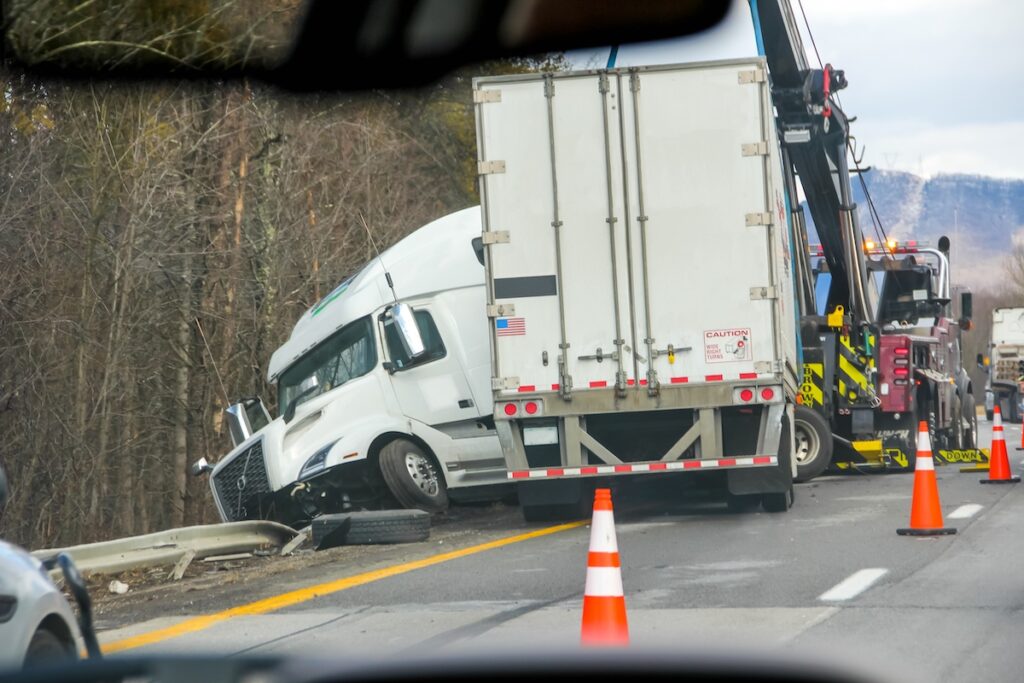
Commercial trucks have a higher center of gravity, which can make them more prone to rollovers. Sharp turns, uneven road surfaces, and high speeds can make commercial trucks more susceptible to tipping, potentially spilling cargo onto the road and putting nearby vehicles at risk.
Rollovers pose more than a threat to the driver of the truck, as they can potentially trigger secondary collisions involving other vehicles.
Driver Fatigue and Pressure to Meet Deadlines
Long-distance commercial truck drivers often work extended hours to meet demanding delivery schedules. This can lead to fatigue, which directly impairs the reaction times, decision-making, and overall focus of the driver.
While federal regulations mandate rest periods, truck drivers may stay on the road for extended hours to meet tight deadlines. Truck accident litigation in Kansas City can help hold a trucking company liable when it fails to enforce proper rest breaks or prioritizes delivery deadlines over driver safety.
Common Causes of Truck Accidents
According to the Federal Motor Carrier Safety Administration (FMCSA), driver error or negligence (defined as “critical reasons” for crashes) accounts for roughly 55% of large truck accidents each year.
This statistic underscores a troubling reality; when those operating 40-ton commercial vehicles fail to exercise the heightened level of caution, training, and judgment required of them, the consequences for other motorists can be catastrophic.
Commercial truck drivers and the companies that employ them carry a responsibility to uphold the highest standards of road safety. These large vehicles demand significantly more skill, control, and situational awareness than the average passenger car to drive.
When a driver operates a truck while fatigued, distracted, impaired, or unqualified, or when a trucking company fails to vet, train, supervise, or properly maintain its fleet, the likelihood of a serious or even fatal collision increases dramatically.
Understanding how and why these accidents happen is a critical first step toward identifying liability, knowing how it contributes to truck accident litigation in Kansas City, and protecting your rights after a collision.
Improper Passing or Turning
Due to the sheer weight and size of heavy trucks and long commercial trailer vehicles, passing and turning safely requires additional training, greater care, and extensive experience. Truck drivers must execute wider turns, carefully consider blind spots, and anticipate how their vehicle movements may affect surrounding traffic.
When a driver attempts a turn or lane change without conducting these necessary checks, the results can be devastating. These errors frequently become central issues in truck accident litigation in Kansas City, where attorneys must demonstrate how improper maneuvers contributed to the collision.

Failing to Check Blind Spots
Also known as “No Zones,” blind spots on commercial trucks are sizable areas around the vehicle’s front, back, and sides where the driver cannot see. Before changing lanes, turning, or emerging, truck drivers must check and double-check their blind spots to ensure that they can safely move their vehicle.
Failing to do so can result in dangerous sideswipes, underride accidents (a severe collision where a smaller vehicle slides under a large truck’s trailer), or fatal crashes.
Intersection Errors
Errors while maneuvering through intersections can result in serious injuries and even fatal collisions. Commonly, vehicle accidents occur frequently at intersections, with data from the Federal Highway Administration showing that accidents are much more common at unsignalized intersections that lack stop signs, yield signs, or any other signs.
These intersection-related errors often lead to severe injuries and, in the most tragic cases, fatalities. Determining which party had the right-of-way is often a pivotal component of truck accident litigation in Kansas City.
Tailgating
Semi-trucks require a much larger stopping distance and take more time to come to a complete halt than passenger vehicles. This is due to their weight, which can be between 35,000 pounds without cargo and up to 80,000 pounds when fully loaded.
When a truck driver follows another vehicle too closely, the odds of a rear-end collision rise exponentially. These collisions can cause life-altering injuries, including traumatic brain injuries, spinal cord damage, and other forms of internal damage.
Unsafe Speeds
When driving large commercial trucks, CDL (Commercial Driver’s License) drivers must pay close attention to their speeds while on the road. Commercial drivers must maintain safe speeds at all times, not only by following posted speed limits but also by adjusting to various road, traffic, and weather conditions.
Maneuvering a large truck too quickly when driving too fast can cause the driver to lose control and jackknife—when a semi-truck trailer comes to an acute angle with the truck cab—or roll the truck.
Truck drivers should know where on their route the speed limit is lower as well. Some areas have a lower speed limit for commercial trucks and a higher one for passenger vehicles. The posted speed limit might allow smaller vehicles to go 70 miles per hour (MPH), but limit commercial trucks to 60 mph instead.
Truck accident cases involving speeding often involve black-box data, which can serve as critical evidence in truck accident litigation in Kansas City.
Driving Under the Influence
Driving while impaired—whether that be under the influence of drugs or alcohol—directly affects reaction times, judgment, and the ability to make safe decisions while behind the wheel. Driving while under the influence of alcohol or drugs is especially dangerous when operating a large truck, as commercial trucks can more easily cause catastrophic damage if drivers lose control or drive recklessly.
Driving under the influence is a major offense under federal regulations, whether that offense occurs while driving a personal vehicle or a commercial truck. For commercial truck drivers, the first offense can result in the revocation of their CDL for one year for regular drivers and three years for drivers hauling hazardous substances.
A second offense can result in a lifetime revocation of CDL driving privileges under federal law. These penalties are in addition to penalties that may be imposed by the state in which the driver is licensed. When impairment contributes to a collision, it frequently becomes a central liability issue within truck accident litigation in Kansas City.
Distracted Driving
Truck driving can be a solitary profession, and many professional drivers spend weeks away from their friends and family while on the job. In the modern age of technology, this can create the temptation to text or talk on a cell phone while driving.
The FMCSA estimated that 71% of commercial truck accidents in 2009 occurred when the driver was distracted, making it an extremely common cause of large-truck accidents.
Focusing on the road should always remain a top priority while operating a large truck. Distracted driving crashes involving two passenger vehicles are often devastating—when these accidents involve large, heavy commercial vehicles, the dangers are even greater. Even a brief moment of inattention or distraction can lead to tragic accidents and life-altering injuries.

When Others’ Negligence Leads to Truck Collisions
In some cases, liability extends beyond the truck driver. Trucking companies, maintenance contractors, loading teams, and even third-party logistics providers may share responsibility. Under the legal doctrine of respondeat superior, employers can be held liable for the actions of their drivers.
These issues often arise in truck accident litigation in Kansas City, where identifying all responsible parties can significantly affect compensation and case strategy.
Unrealistic Schedules
Imposing unreasonable delivery schedules may pressure drivers to speed, skip required rest breaks, or overlook safety protocols. When a company prioritizes delivery times over safety, resulting accidents may expose the company to direct liability.
Unsecured Loads
Improperly loading or failing to secure cargo could lead to a spill, which can block the roadway, cause traffic accidents, and even hit nearby vehicles. These accidents can be devastating, leading to severe injuries and even fatalities. Even when unsecured cargo remains inside the trailer, significant shifts within a trailer can still cause a commercial truck to tip over.
The trucking company, warehouse, or distribution center might be liable for an accident caused by an unsecured load, depending on the specific details of the accident.
Oversized Loads
With the proper permits, trucking companies can have their drivers carry oversized loads. In some cases, these loads can be wider than the truck. This can cause the vehicle to take up more than two lanes of traffic, leading to additional challenges in properly navigating the roads.
Exceptional care must be taken in transporting oversized loads. The trucking company must follow specific regulations and stipulations to haul loads of this size, and must pass this information along to its drivers. When they fail to do so, the likelihood of an accident increases.
Visual Obstructions
When driving with an oversized load, commercial truck drivers may find it difficult or impossible to see around their cargo or manage other tasks, like ensuring their cargo can pass through the assigned route properly. In cases like this, they must have a crew available to help them navigate properly.
These crews are responsible for relaying info to the drivers, helping them navigate their route, and warning other motorists about the large, oversized load of the truck. The trucking company must provide this crew in situations when a driver cannot safely drive without them.
Poorly Screened Drivers
Trucking companies must properly vet their drivers through the FMCSA Pre-Employment Screening Program. This program aims to put safe and reliable drivers behind the wheels of commercial trucks, working to reduce collisions and save lives.
Having the knowledge, skills, and experience to safely operate a commercial truck goes far beyond holding an up-to-date CDL. Understaffed or over-obligated companies can sometimes forgo screening processes.
This can lead to drivers being hired who have poor driving records, a history of drug or alcohol use, and other dangerous driving habits. This may be considered negligent hiring. If a company learns about violations and continues to staff this driver, this may be considered negligent retention.
Other Compliance Violations
Compliance violations stem from violating any state or federal rules or regulations that are in place to prevent accidents and promote safe driving.
Some common compliance violations include:
- Driving with a suspended or revoked CDL
- Failing to implement and enforce mandated safety practices
- Failing to provide proper training
- Failing to randomly test for drugs and alcohol
Trucking companies are responsible for compliance obligations in their drivers, trucks, and equipment. When an accident occurs because of a compliance violation—like if a company fails to properly test their drivers, and a driver is involved in an accident while intoxicated—the company may be liable.
These violations often provide powerful evidence during truck accident litigation in Kansas City.
Truck Accident Litigation in Kansas City
Semi-truck accidents are often more severe because these trucks are larger and heavier than standard vehicles the public drives. Large trucks are 20 to 30 times heavier than a typical passenger vehicle, and the average size of a semi-truck in the United States is 72 feet long, 8.5 feet wide, and 13.5 feet tall.
When a car and semi-truck are involved in a collision, the individual in the standard vehicle is more likely to experience the following serious injuries:
- Psychological trauma
- Broken bones
- Amputations
- Spinal cord injuries
- Brain injuries
Considering What’s at Stake
Trucking accidents are often catastrophic events that require experience to litigate. Trucking accident attorneys will understand what is at stake in these accidents. When choosing an attorney to handle truck accident litigation in Kansas City, consider the following:
- Does the attorney have access to litigation resources and the ability to work with expert witnesses to prosecute the case?
- Will the lawyer have the experience needed to adequately investigate the crash?
- Has the lawyer effectively handled trucking cases in the past?

Navigating Complex Claims With a Truck Accident Attorney
In the aftermath of a commercial trucking accident, determining liability and securing fair compensation can be an intricate process. These cases often involve multiple parties, complex regulations, and high-stakes insurance negotiations, which makes experienced legal representation essential.
An attorney with experience in truck accident litigation in Kansas City will conduct a thorough investigation into the circumstances of the crash. This includes securing critical evidence such as accident reports, electronic logging device (ELD) data, driver qualification reports, maintenance records, and relevant medical documentation. Each of these elements plays a pivotal role in establishing liability and building a strong claim.
Equally important, seeking legal counsel ensures a powerful advocate is by your side when dealing with commercial insurers. Trucking companies and their carriers are backed by legal teams whose primary aim is to minimize payouts to victims. Without representation, victims face significant disadvantages during negotiations.
By working with an experienced truck accident attorney, victims gain an advocate who can navigate the legal and procedural complexities, counter aggressive defense tactics, and pursue the full compensation necessary for recovery.
Determining Liability in Truck Accident Cases
Working to determine the liability for a commercial truck accident requires careful attention to detail and thorough examination. Multiple parties can potentially be responsible for a crash, which makes determining liability more challenging.
Truck accident litigation in Kansas City is often required to determine which key individuals or entities may be held liable for the damages caused by a commercial truck collision. Some examples of potentially liable parties include:
- Commercial Truck Driver
If a commercial truck driver’s actions directly lead to an accident, they may be held accountable for the resulting injuries and damages.
If a driver did something illegal while driving—like texting while driving, driving under the influence, or generally violating traffic laws—the driver is typically liable for the damages caused due to these illegal actions.
- Trucking Companies
Trucking companies are responsible for maintaining their fleets of vehicles and ensuring that their drivers are properly trained and qualified to operate the vehicles they drive. If a company fails to maintain a commercial truck, fails to follow safety regulations, or employs an unqualified driver, they may be partially or fully liable for the accident.
If a trucking company encourages unsafe driving practices, like skipping required breaks or rest requirements to meet deadlines, they may share partial responsibility for the crash and damages.
- The Truck’s Manufacturer
Commercial trucking accidents can occur due to a defect in a truck’s safety equipment. This includes failures like faulty brakes, an ineffective under-ride guard, or other mechanical defects. When an issue exists when a truck leaves the factory, it can be classified as a “defect”.
When a defect causes or fails to prevent a collision, the manufacturer may be held liable for defect-related accidents. An attorney who is experienced in truck accident litigation in Kansas City can help victims determine if a defect played a role in a truck collision.
- The Cargo Loader
Commercial trucks often carry cargo containers that other companies have loaded and packed. Cargo loading is subject to numerous regulations and rules, typically requiring cargo to be adequately secured, tied, and anchored when packed.
Cargo must also be positioned so it does not fall out of the truck, with special rules regarding specific types of cargo—like concrete, pipes, and building products. Improperly packed cargo can potentially lead to accidents.
Some examples of cargo-related causes of truck accidents include:
- Failing to secure the cargo within the cargo container
- Overloading a cargo container
- Improperly loading a cargo container with hazardous materials
- Failing to properly balance a cargo container’s load
If loose or overweight cargo contributed to a truck accident, a victim should seek guidance from an attorney experienced in truck accident litigation in Kansas City, who can help them take the proper steps to secure compensation.
- Government Entities
In some cases, unsafe road conditions can contribute to a commercial truck accident. Negligent road construction, inadequate road maintenance, and dangerous road construction zones are examples of several road-related issues that can give rise to claims against specific agencies and contractors that may be liable in the event of an accident.
Bartimus Frickleton Robertson Rader Can Handle Large Truck Accident Litigation in Kansas City
The lawyers at Bartimus Frickleton Robertson Rader understand that large truck accident litigation in Kansas City requires vigorous representation and experience. When representing a client or a family after a trucking accident, we devote time and resources and have the experience to achieve the best possible result.
For more than 40 years, the attorneys at BFRR have successfully represented some of the region’s most high-profile and high-stakes cases. Although we are centrally located, we have a national impact.
If you or a loved one suffered an injury after a tractor-trailer accident, contact our personal injury lawyers today for a consultation at no cost.
The above is not intended to be legal advice. Each individual case is different and must be analyzed on its own set of facts and circumstances. If you believe you may have a case, it is critically important that you timely contact a lawyer to ensure your rights are protected.